🚀 WhatsApp Bulk Messaging System – Distributed Automation Project
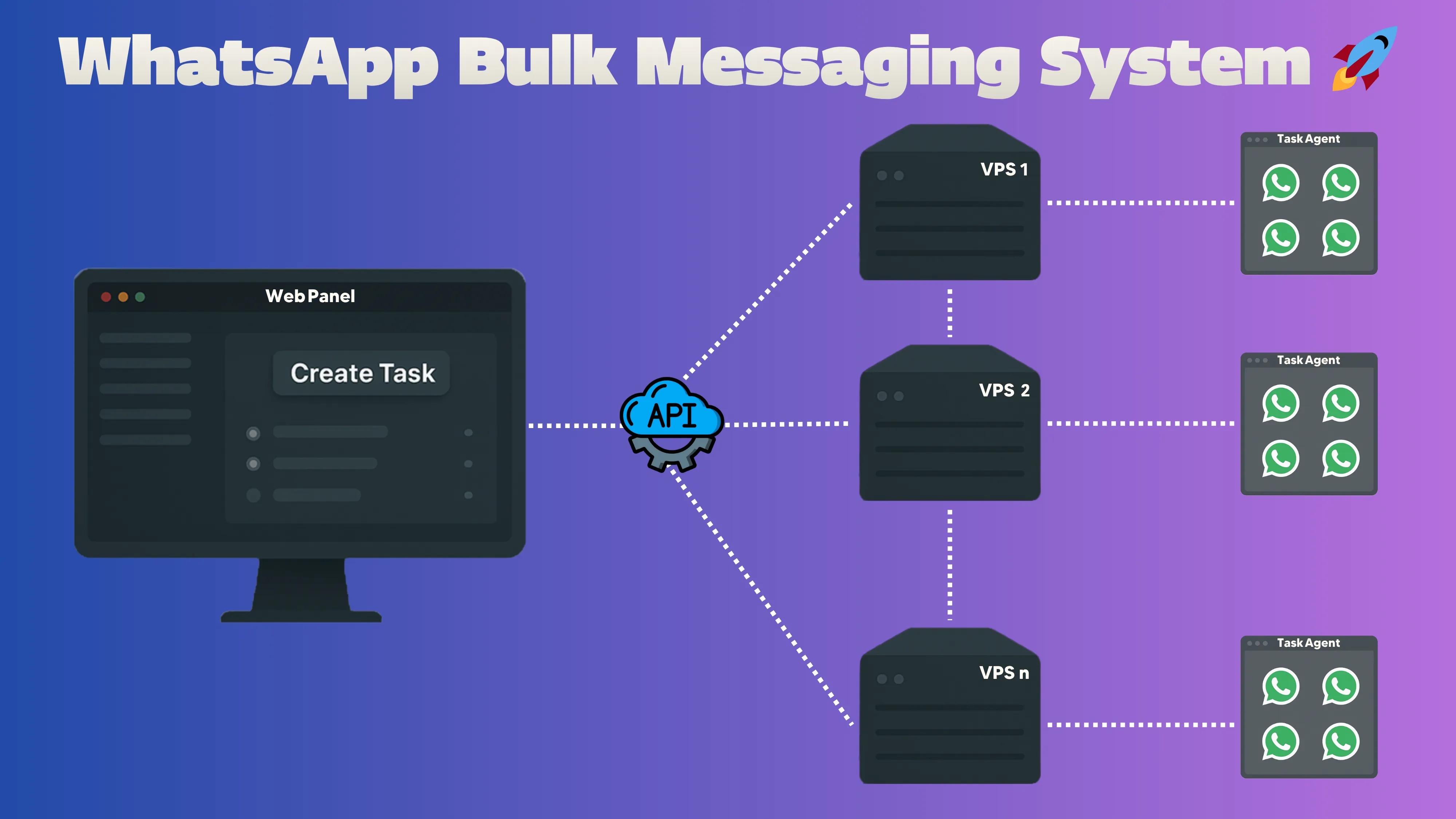
I’m excited to share one of my recent projects: WhatsApp Bulk Messaging System, a distributed platform built using Python, Django, REST API, and PyQt.
This project is designed to automate large-scale WhatsApp message delivery through multiple client instances connected to a centralized web panel.
💡 Project Overview
The system consists of two main components:
Web Panel (Django + REST API):
A centralized dashboard that allows users to manage message campaigns, add WhatsApp accounts, define message tasks, and monitor delivery status in real-time.
Client Application (PyQt)
Runs on multiple virtual servers or PCs, receives assigned tasks from the API, and executes message-sending operations automatically — fully synchronized with the web panel.
⚙️ Key Features
✅ Central web dashboard for managing tasks and campaigns
✅ Add and manage multiple WhatsApp accounts across different clients
✅ Real-time synchronization between clients and the web panel via API
✅ Message scheduling and automation
✅ Bulk text and media message sending (text, image, caption, etc.)
✅ Automatic retry system for failed messages
✅ Live statistics and progress tracking
✅ Secure database storage and user authentication
✅ Multi-server architecture — scalable and fault-tolerant
🌍 Why I Built It
Initially, I created this tool as a personal project during my university years to experiment with automation and distributed communication systems.
Later, I extended it into a multi-client architecture, capable of handling hundreds of concurrent message deliveries efficiently.
This project helped me explore concepts like API-based synchronization, distributed task execution, asynchronous message handling, and performance optimization.
🖥 Technical Stack:
Backend: Python, Django REST Framework
Frontend: Django Templates, JavaScript
Client App: Python (PyQt)
Database: PostgreSQL
Communication: REST API + JSON
Deployment: Windows / Linux virtual servers